
Most executives are currently paying for the privilege of being ignored by Google’s most sophisticated algorithms. If you are still writing $459 checks for mid-tier guest posts that yield zero referral traffic, you aren’t building authority; you’re subsidizing someone else’s content farm. The reality of 2026 is that Google’s SpamBrain AI has effectively neutralized the “pay-to-play” model of traditional outreach. To win now, you must understand the strategic divide of editorial link building vs guest blogging. One is a volume-based gamble that invites penalties, while the other is a merit-based system that secures your seat in publications like Entrepreneur or TechCrunch.
You already know that superficial metrics don’t translate to market dominance. It’s time to stop chasing links and start building genuine industry standing. This executive guide reveals why editorial placements are the only way to establish a founder as a true thought leader while creating SEO equity that competitors can’t touch. We will break down the mechanics of high-tier media relations and provide the framework to ensure your brand’s digital visibility is built on substance rather than temporary schemes.
Key Takeaways
- Transition from seeking permission to commanding attention by focusing on merit-based strategies that bypass modern AI-driven SEO filters.
- Evaluate the impact of “Single Source of Truth” placements and why one elite mention triggers a cascade of secondary authority signals that competitors cannot replicate.
- Navigate the critical trade-offs in editorial link building vs guest blogging to ensure your capital is invested in long-term brand equity rather than temporary visibility.
- Shift your internal processes from volume-driven outreach to a sophisticated media relations model designed to secure features in household-name publications.
- Implement a selection framework that aligns your link-building strategy with your specific growth stage, whether you are building a foundation or scaling market dominance.
Editorial Link Building vs. Guest Blogging: Defining the Professional Standard
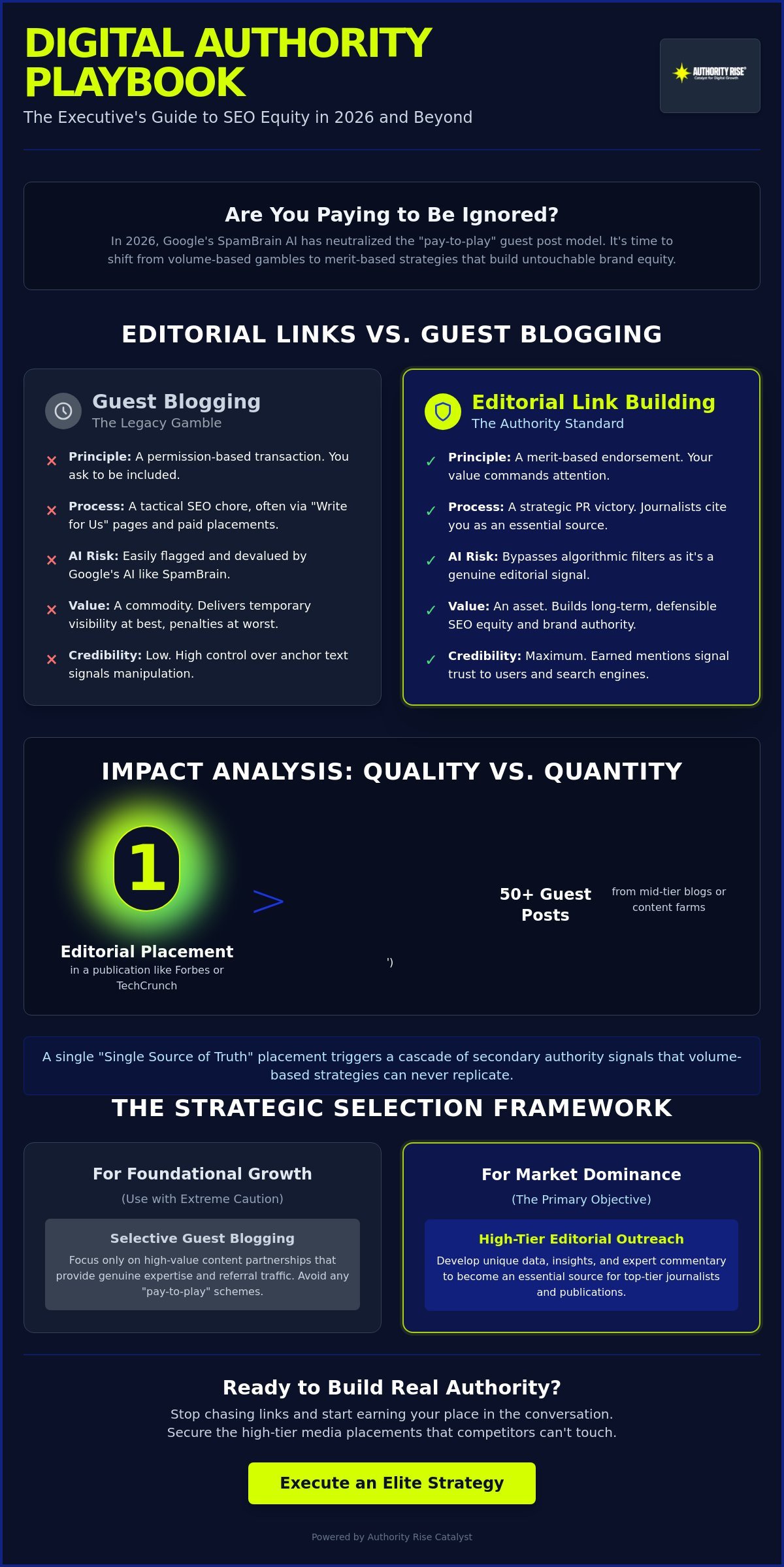
The distinction between editorial link building vs guest blogging isn’t merely semantic; it’s the difference between a transaction and an endorsement. Guest blogging is a permission-based strategy. You provide content to a site that openly accepts outside contributors, often through “Write for Us” pages or paid placements. It’s a tactical SEO chore. In contrast, editorial link building is a merit-based strategy. A journalist or editor includes your link because it provides essential value to their story. This is a strategic PR victory. One relies on your ability to follow instructions; the other relies on your brand’s inherent authority.
For founders and executives in 2026, understanding this divide is non-negotiable. Traditional Link building often prioritizes volume over validity. However, search engines now use AI-powered systems like SpamBrain to devalue low-effort contributions in real-time. If you can buy a link with a credit card and a generic 500-word article, your competitors can do the same. That isn’t a competitive advantage. It’s a commodity. True market leaders don’t settle for commodities. They secure placements that represent a high-level influence and long-term value.
The Evolution of Guest Blogging in 2026
The era of “pay-to-play” guest posts is fading into a liability. High-growth brands no longer settle for “Write for Us” directories that exist solely to sell links. In 2026, guest blogging has evolved into sophisticated content partnerships. The focus has shifted toward authentic, high-value contributions where the brand provides genuine expertise that a site’s audience actually wants to read. If a placement doesn’t offer referral traffic or brand alignment, it’s a wasted resource. You can find more insights on these shifts in our latest strategy reports.
What Makes a Link “Editorial”?
True editorial links represent the gold standard of third-party validation. They are almost always unsolicited. An editor at a high-tier publication finds your resource, data, or insight and cites it because it strengthens their narrative. Contextual relevance is the primary driver here. A single link inside a Forbes feature or an Entrepreneur profile carries more weight than 100 niche blog posts because it carries the weight of journalistic integrity. It’s an earned mention that signals trust to both users and algorithms. This type of placement is reserved for those who prioritize substance over superficial gains.
The core difference comes down to control versus credibility. Guest blogging offers high control over the anchor text but low credibility in the eyes of a sophisticated search engine. Editorial links offer low control over the specific placement but maximum credibility. In a landscape where Google prioritizes “Helpful Content,” the lack of control is actually your greatest asset. It proves that a neutral third party found your brand worth mentioning without a direct incentive.
The Mechanics of Authority: Earned Merit vs. Granted Permission
Stop asking for permission. It’s a weak strategic position that signals your brand is just another voice in a crowded room. When you seek a guest post, you’re essentially asking a gatekeeper for a favor, which immediately devalues your contribution. Editorial link building flips this dynamic. It shifts the focus from “Can I post here?” to “Why can’t you write this story without my data?” This is the core of earned merit. It’s about becoming an essential resource rather than a temporary guest.
Comparing editorial link building vs guest blogging reveals a fundamental truth: search engines reward the difficult path. Guest posts often trigger what we call the “SEO filter.” Because they follow predictable patterns, such as standardized author bios and specific anchor text placements, Google’s AI-led classifiers can easily identify and devalue them. Editorial links bypass this filter entirely. They are woven into the fabric of a story by a neutral third party. This creates a level of trust and algorithm resistance that no amount of volume-based guest posting can match.
The lifecycle of these two approaches couldn’t be more different. A guest post inquiry is a transaction. It’s a predictable, linear process that ends when the check clears and the post goes live. An editorial pitch is a relationship. It’s a high-stakes engagement with the news cycle that requires precision and speed. If you’re ready to move beyond the permission trap, our team can help you refine your strategic approach.
The Editorial Bar: Pitching Journalists and Editors
To clear the editorial bar, your brand must align with the current news cycle. Journalists don’t care about your product; they care about their audience. This is where the “Data-Led Hook” becomes your most powerful asset. Original research and proprietary insights are the currency of the modern media landscape. By providing unique data, you become the primary source. This is a central pillar of our Data Driven PR Campaigns, where we transform raw information into high-tier media mentions.
The Permission Trap: Why Guest Blogging Often Stagnates
Guest blogging platforms have become saturated. Many sites that once held prestige have devolved into “link farms” that sell space to anyone with a budget. This creates a diminishing return on your investment. Google’s SpamBrain system is designed to detect these clusters of low-quality, high-volume links. When you rely on low-barrier-to-entry tactics, you aren’t just wasting money. You’re building your brand on a foundation that the next algorithm update could easily sweep away. True authority requires a more sophisticated, merit-based framework.
Impact Analysis: Why One Editorial Placement Outperforms Fifty Guest Posts
Stop collecting digital junk. Most backlink profiles are cluttered with low-tier guest posts that provide the illusion of progress while offering zero actual protection against algorithm shifts. The “Single Source of Truth” effect is the primary reason why elite brands dominate search results. A single high-tier editorial placement often triggers a cascade of secondary mentions across the web. When a publication like TechCrunch or Entrepreneur cites your proprietary data, smaller industry blogs naturally follow suit. They cite the original story, creating a high-authority link web that you don’t have to manually build or pay for.
In the strategic evaluation of editorial link building vs guest blogging, you must account for the hidden cost of ghost traffic. Many sites that openly sell guest posts boast impressive Domain Rating (DR) metrics but receive negligible human visitors. These platforms are essentially script-driven facades. An editorial placement in a household-name publication provides genuine referral traffic from real decision-makers. It transforms your conversion rate instantly. The psychological impact of an “As Seen In” section featuring major media logos provides a level of trust that a mountain of niche blog posts can’t replicate.
SEO Performance and the 2026 Algorithm
AI-driven search engines (SGE) have fundamentally redefined Source Authority. In 2026, AI citations prioritize established editorial sources with high “Trust Rank” over generic, contributor-led content. Link equity is the quantitative value and qualitative trust passed from a high-authority source to your domain, acting as a definitive endorsement of your brand’s market relevance. Research from early 2026 indicates that websites receiving just 5 to 10 high-quality placements per quarter see an average organic traffic increase of 23% over six months. This efficiency is impossible to achieve through low-quality volume tactics.
Executive Visibility and Brand Dominance
Securing elite placements is the cornerstone of Authority Building for CEOs. A feature in a major publication doesn’t just move a keyword; it changes how investors, partners, and competitors perceive your leadership. It’s a high-stakes signal of influence. You can turn a single editorial win into a multi-channel marketing campaign by leveraging the mention across social media, email newsletters, and investor decks. This creates a narrative of dominance that positions you as the definitive voice in your industry.
The Selection Framework: When to Use Each Strategy
Strategy without situational awareness is just expensive guesswork. When deciding on editorial link building vs guest blogging, your choice must be dictated by your current market position rather than a generic industry checklist. If you are in the early stages of building a digital footprint, a controlled volume of high-quality guest blogging can establish niche relevance and foundational visibility. However, if your objective is to scale market dominance and protect your brand from future algorithm volatility, your capital belongs in editorial PR.
Resource allocation should mirror your growth objectives. Guest blogging is a tactical tool for filling specific content gaps or targeting long-tail keywords. It’s relatively predictable and scalable. Editorial link building requires a higher upfront investment in research and media relations, but the payoff is an exponential increase in brand equity. Auditing your current backlink profile for “quality bloat” is a critical executive function. Many brands suffer from a surplus of low-impact links that inflate metrics without moving the needle on revenue. You want a lean, high-authority profile that commands respect from both users and search engines.
A hybrid approach often works best for established leaders. Use guest blogging to secure hyper-specific industry relevance in niche publications and reserve editorial link building for the heavy lifting of brand authority in household-name media. This ensures your profile looks natural to search engines while carrying the weight of elite endorsements. This balanced distribution of assets creates a defensive moat that competitors cannot easily replicate through simple outreach.
Red Flags in Guest Blogging: Avoiding the “Link Farm” Trap
Stop investing in sites that exist solely to sell links. If a blog features a “Write for Us” page prominently in its navigation, it’s likely a liability. These platforms often apply “sponsored” or “contributor” tags that strip the link of its SEO value. Analyze the site’s traffic data. If a domain has a high DR but zero organic visitors, you aren’t buying a backlink; you’re buying a ticket to a Google penalty. Google’s SpamBrain system is specifically trained to identify these patterns of artificial growth.
Identifying High-Value Editorial Opportunities
Adopt a “Journalist First” mindset to secure the placements your competitors can’t reach. This involves identifying the specific writers who cover your industry and understanding the gaps in their current coverage. Use media monitoring tools to track where your competitors are being mentioned and identify editorial gaps where your proprietary data could provide a fresh angle. If you’re ready to move beyond basic blogging, contact our strategists for an editorial audit that identifies your highest-leverage opportunities.
Executing an Elite Strategy: The Authority Rise Catalyst Approach
Execution is where most authority campaigns fail. While many agencies treat link building as a volume-driven numbers game, we treat it as a high-stakes craft. The fundamental shift in editorial link building vs guest blogging is moving from “outreach” to “media relations.” Generic outreach involves sending thousands of templated emails to webmasters of low-tier blogs. Media relations involves cultivating direct lines to journalists and editors at household-name publications who are looking for the next definitive industry insight. It’s the difference between being a solicitor and being a source.
Our full-cycle management process handles the entire strategic arc. We identify the specific narrative angles that align with the current news cycle, develop the proprietary data or expert commentary required to anchor the story, and manage the direct communication with editorial rooms. Founders need a specialist partner because top-tier editors don’t respond to cold pitches from unknown entities. They respond to established strategists who consistently deliver high-value assets. Consider the ROI: a single feature in Forbes can generate more qualified leads and search equity than a full year of fragmented guest blogging. It’s about high-level influence over superficial noise.
Integrating Digital PR with Enterprise SEO
We bridge the gap between PR buzz and technical SEO requirements to ensure every mention serves your bottom line. Traditional PR often fails to secure the specific “Contextual Anchors” that signal authority to search engines. We ensure that your placements aren’t just vanity mentions; they are strategic assets that pass significant link equity to your most important service pages. This precision is detailed further in our Forbes Executive Strategy guide, which outlines how to turn media coverage into a ranking powerhouse.
Your Path to Market Dominance
Success in the editorial landscape requires a disciplined timeline. While guest posts might go live in days, elite editorial placements often take weeks or months to secure as they move through rigorous vetting processes. However, the compounding effect of a sustained authority campaign is unmatched. Each high-tier win makes the next one easier to secure, creating a momentum that eventually makes your brand the default choice for journalists. It’s time to stop chasing permission and start commanding the narrative. Secure your place in the conversation with an elite editorial strategy that actually moves the needle.
Commanding the Narrative in a Post-AI Landscape
Market leadership in 2026 requires a departure from commodity tactics. You’ve seen the data: while guest blogging offers control, it lacks the raw authority needed to survive sophisticated algorithm shifts. Transitioning your focus to merit-based placements isn’t just an SEO upgrade; it’s a total brand transformation. By understanding the strategic nuances of editorial link building vs guest blogging, you move your business from a solicitor of space to a primary source of industry truth. One earned mention in a household-name publication creates a defensive moat that no volume of low-tier posts can penetrate.
Stop settling for superficial metrics. Our team brings over four years of experience in elite media relations to help you secure the visibility your brand deserves. We’ve consistently secured high-impact placements in Forbes, Entrepreneur, and TechCrunch using a rigorous, data-driven approach to brand authority. It’s time to leverage our strategic depth to establish your founder as a definitive thought leader. Request an Editorial Strategy Consultation to begin your ascent. Your seat at the top of the industry conversation is waiting.
Frequently Asked Questions
What is the main difference between editorial link building and guest blogging?
The primary distinction lies in the source of the endorsement. Editorial link building is a merit-based strategy where an editor cites your brand because it adds essential value to their story. Guest blogging is a permission-based tactic where you provide content to a site that openly accepts outside authors. One is an earned PR victory while the other is a tactical content exchange.
Is guest blogging considered a “black hat” SEO tactic in 2026?
Guest blogging remains a legitimate practice provided the focus is on helpful content and human expertise. It isn’t “black hat” by default, but Google’s SpamBrain AI now devalues unnatural, large-scale patterns in real-time. If your campaign relies on low-quality content farms or automated outreach, you are inviting a penalty. Authentic contributions to relevant publications are still safe and effective.
How much does editorial link building cost compared to guest blogging?
Editorial placements generally require a higher strategic investment than standard guest blogging. This reflects the intense research, data collection, and media relations needed to clear the high editorial bar. While guest posts are often commoditized transactions, editorial links are bespoke assets. You are paying for the expertise required to navigate high-tier editorial rooms rather than just buying space on a blog.
Can I get editorial links without being a well-known founder?
You can secure elite placements without a public profile by leveraging proprietary data. Journalists and editors prioritize unique insights over personal fame. If you provide original research or a counterintuitive industry analysis, you become an essential source. This merit-based approach allows unknown founders to bypass traditional gatekeepers and appear in household-name publications alongside industry veterans.
How long does it take to see SEO results from an editorial link building campaign?
Most brands observe measurable organic traffic increases within three to six months of a sustained campaign. While a feature in a major publication provides immediate referral traffic, the SEO link equity compounds over time. This reflects Google’s process of validating the third-party endorsement. In competitive niches, a single high-quality editorial link often outperforms dozens of lower-tier placements within that same timeframe.
Do editorial links ever lose their value?
Editorial links are among the most durable assets in digital marketing. They don’t lose value because they represent genuine journalistic integrity and contextual relevance. Unlike guest posts that might be purged during a site audit or devalued by a “helpful content” update, editorial mentions are woven into the site’s permanent narrative. They provide long-term SEO equity that competitors can’t replicate.
How do I know if a guest blogging opportunity is high quality?
A high-quality opportunity is defined by human traffic and strict vetting. If a site has a “Write for Us” page and accepts any submission, it’s likely a link farm. High-tier opportunities involve a rigorous review process and a clear alignment with the site’s core audience. You should analyze the domain’s organic search visibility to ensure real people are actually reading the content.
What is the “Merit vs. Permission” framework in SEO?
The “Merit vs. Permission” framework distinguishes between begging for visibility and commanding it. Permission-based SEO involves asking gatekeepers for a favor, which inherently devalues your brand. Merit-based SEO focuses on providing such significant value that your inclusion is a necessity for the publication. This framework is essential for understanding the strategic divide of editorial link building vs guest blogging in a post-AI world.
Disclaimer
Website Blog Disclaimer
Last Updated: June 28, 2026
The information published on the Authority Rise Catalyst blog is provided for general informational and educational purposes only. While we strive to ensure that all content is accurate, relevant, and up to date, we make no guarantees regarding the completeness, accuracy, reliability, or suitability of any information on this website.
The content on this blog should not be considered professional legal, financial, tax, medical, or business advice. You should always consult a qualified professional before making decisions based on the information provided here.
Authority Rise Catalyst shall not be held liable for any loss, damage, or inconvenience arising from the use of, or reliance upon, the information available on this website. Your use of this website and its content is entirely at your own risk.
Some articles may contain links to third-party websites for your convenience. We do not control or endorse the content, services, or policies of these external websites and are not responsible for any information or services they provide.
Certain blog posts may contain affiliate links. If you purchase products or services through these links, we may earn a small commission at no additional cost to you. These commissions help support the operation and maintenance of our website. We only recommend products or services that we genuinely believe may provide value to our readers.
Some content may be created or enhanced using artificial intelligence (AI) tools. Every effort is made to review and edit AI-assisted content before publication; however, errors or omissions may still occur.
All opinions expressed on this blog are those of the respective authors and do not necessarily represent the views of any organizations, companies, or clients associated with Authority Rise Catalyst.
All text, graphics, logos, images, and other content published on this website are protected by applicable copyright and intellectual property laws unless otherwise stated. Unauthorized reproduction, distribution, or commercial use of any content is prohibited without prior written permission.
By accessing and using this website, you acknowledge that you have read, understood, and agreed to this disclaimer. We reserve the right to modify or update this disclaimer at any time without prior notice. Continued use of the website after changes constitutes acceptance of the updated disclaimer.
If you have any questions regarding this disclaimer, please contact us through the contact page on our website.