
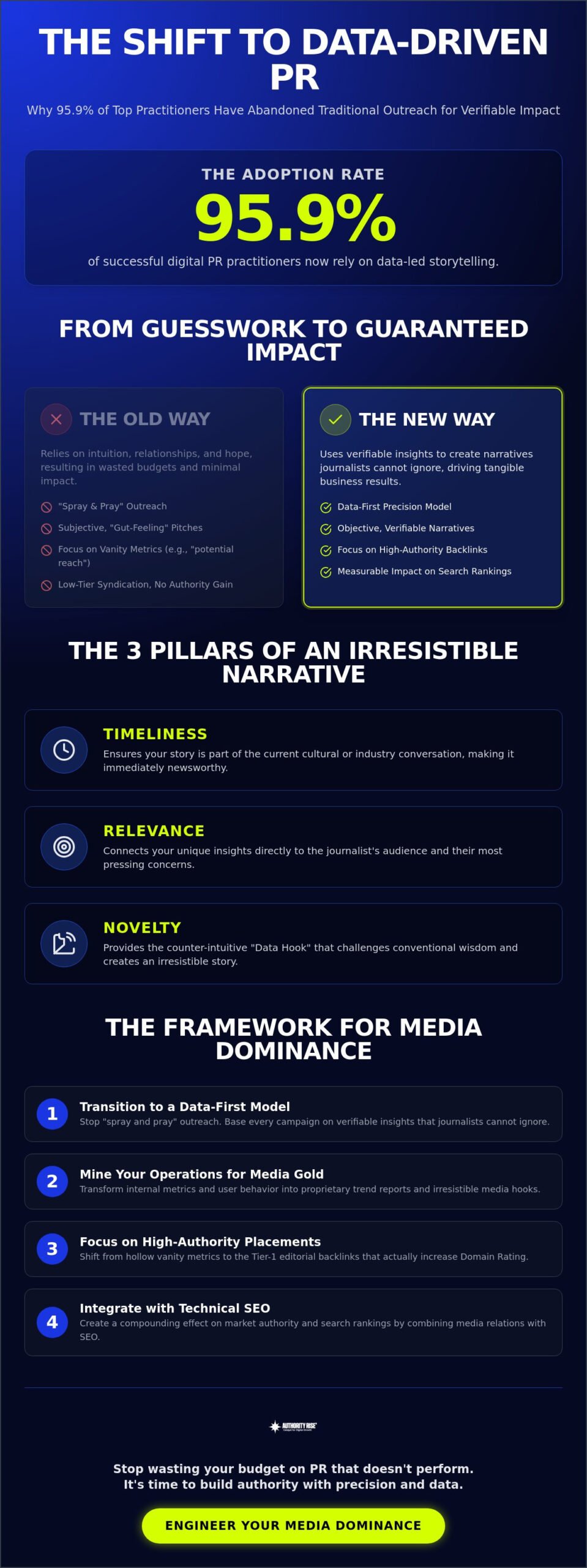
95.9% of the most successful digital PR practitioners now rely on data-led storytelling because it’s the only remaining way to reliably capture the attention of overextended journalists. If you’re still relying on traditional outreach, you’re essentially shouting into a void where the vast majority of your peers have already pivoted to more sophisticated, data driven PR campaigns. Most executives have felt the frustration of a wasted budget on agencies that deliver nothing but “syndication” on obscure sites. It’s a common failure that stems from a lack of substance. We prefer a more surgical, merit-based approach.
You already know that high-authority editorial placements are the only currency that truly increases your Domain Rating and positions you as a category-defining leader. This guide explains how to leverage proprietary data to bypass media gatekeepers and secure the Tier-1 placements that drive search rankings. We will examine the shift from vanity metrics to measurable search impact, providing a strategic blueprint to turn your internal insights into a dominant market presence.
Key Takeaways
- Stop wasting budget on “spray and pray” outreach and transition to a data-first precision model that journalists cannot ignore.
- Master the three pillars of a high-impact narrative-timeliness, relevance, and novelty-to transform internal metrics into irresistible media hooks.
- Shift your focus from hollow vanity metrics to the high-authority editorial backlinks that define successful data driven PR campaigns.
- Follow a disciplined strategic framework to discover contrarian insights and build high-value assets like whitepapers and interactive data visualizations.
- Discover how integrating high-level media relations with technical SEO creates a compounding effect on your brand’s market authority and search rankings.
The Death of Intuition: Why Traditional PR Fails Modern Brands
The era of the “gut-feeling” pitch is over. For decades, Public relations relied on the strength of a Rolodex and the hope that a journalist might find a corporate announcement mildly interesting. This “spray and pray” methodology is not just outdated; it’s a liability. In 2026, journalists are inundated with thousands of AI-generated pitches every day. They’ve developed a biological filter for anything that smells like marketing fluff. If your strategy doesn’t provide immediate, verifiable value, it goes straight to the trash.
Successful data driven PR campaigns replace intuition with precision. This strategy uses quantifiable insights to craft narratives that journalists cannot ignore. It isn’t about telling the media what your company does. It’s about showing them what the world is doing based on your unique data. Most PR fails because it lacks a verifiable, objective hook. Without data, you’re just another brand asking for free advertising. With it, you’re a source of truth. You’re no longer begging for coverage; you’re providing the evidence that makes a story worth writing.
The High Cost of Vague Media Relations
Standard press releases offer diminishing returns in our current digital landscape. Blasting a generic announcement across a newswire might result in a few syndicated hits on low-tier sites, but these do nothing for your brand’s actual standing. This ego-driven PR is a trap. It wastes executive time and burns through capital while delivering zero high-authority editorial placements. There’s a massive disconnect between traditional metrics, like potential reach, and the actual business authority required to dominate a market. If you can’t measure the impact on your search visibility or industry influence, the campaign has failed. Precision beats volume every time.
Shifting from Subjective Pitches to Objective Authority
The transition from subjective storytelling to objective authority is the hallmark of an elite brand. We’ve moved past the “we think this is interesting” phase of media relations. Now, the mandate is simple: the data proves this is happening. When you present a journalist with proprietary metrics or a synthesis of public data, you’re reducing their risk. Editors want stories that are bulletproof. Data-backed narratives provide that armor. This builds Editorial Trust, a measurable asset that ensures your brand isn’t just a one-hit wonder in the news cycle. It positions you as a practitioner who understands the mechanics of influence. If you’re ready to stop guessing and start leading, it’s time to connect with strategists who prioritize substance over hype.
The Mechanics of an Irresistible Data-Led Narrative
High-tier editors don’t care about your product roadmap. They care about the friction between what people believe and what is actually happening. To bridge this gap, your narrative must rest on three non-negotiable pillars: timeliness, relevance, and novelty. Timeliness ensures you’re part of the current cultural or industry conversation. Relevance connects your insights to the reader’s immediate concerns. Novelty provides the “Aha!” moment. This moment is born from the Data Hook. A Data Hook is the specific statistical anomaly that challenges industry conventional wisdom. It’s the friction point that forces a reader to stop scrolling.
Successful data driven PR campaigns don’t just present numbers. They present a perspective. You can source this from proprietary surveys, internal platform metrics, or a sophisticated synthesis of public data. The goal is to find the counter-intuitive insight. If everyone says the market is growing, but your data shows a 12% contraction in a specific niche, you have a story. This contrast-and-correct approach is what separates elite strategists from average marketers. You aren’t just reporting data; you’re defining the reality of your industry.
Mining Your Own Operations for Media Gold
Your internal user behavior is a goldmine of editorial content. Identify “hidden” trends by looking at how your customers interact with your platform. A SaaS company might analyze usage logs to identify that users are abandoning a specific legacy feature in favor of a newer, more efficient workflow. This can be packaged as a national trend report on changing productivity habits. Precision is key. You must anonymize data to comply with 2026 regulations like the Indiana Consumer Data Protection Act. Protecting privacy isn’t just a legal requirement. It’s a fundamental component of brand trust.
Validating Trends with External Data Synthesis
Internal data alone can feel anecdotal. To secure a spot in TechCrunch or Forbes, you need a “Validation Layer.” This involves “Data Triangulation.” You connect your internal metrics to Google Trends, government reports, or industry benchmarks. This ensures your strategic KPI alignment reflects a global narrative rather than an isolated incident. By anchoring your unique findings in broader market shifts, you reduce the editorial risk for busy journalists. If you want to transform your internal metrics into a market-dominating narrative, consult with our strategic team to build your next campaign.
Vanity Metrics vs. Strategic KPI Alignment
Most PR reports are filled with impressive-looking numbers that mean absolutely nothing for your bottom line. “Impressions” are the ultimate vanity metric. They represent potential eyeballs, not confirmed influence. A campaign that claims “ten million impressions” but fails to move the needle on your search visibility is a failure of strategy. We prioritize substance over superficial reach. In the world of high-stakes media, “Editorial Backlinks” are the only currency that matters. These links represent a transfer of authority from a trusted publication to your brand, a dynamic that search engines in 2026 value above all else.
The math of authority is simple but often ignored. A single link from a publication like Forbes or Entrepreneur carries more weight than 1,000 directory submissions or low-tier blog mentions. This is because search algorithms have evolved to recognize the difference between a paid placement and a merit-based editorial citation. High-impact data driven PR campaigns are designed to secure these elite placements by providing the proprietary insights that major editors crave. By focusing on Domain Rating (DR) as a primary success metric, you align your PR efforts with your long-term SEO goals. You aren’t just generating noise; you’re building a permanent foundation of digital authority.
Citing sophisticated data-driven PR strategies highlights how information acts as the bridge between a simple mention and a high-authority placement. Data is the key that unlocks doors that are otherwise closed to traditional marketing pitches.
The SEO Impact of Earned Media
In 2026, editorial links pass “trust signals” that algorithms prioritize to combat the flood of AI-generated content. There is a direct correlation between high-tier media mentions and organic search visibility. Even “No-Follow” links from major publications carry immense brand weight. While they may not pass direct link equity, they signal to search engines that your brand is a legitimate entity within your niche. This validation is essential for maintaining a dominant position in competitive search results.
Measuring Sentiment and Brand Salience
Elite strategy moves beyond click-through rates to analyze how data narratives change market perception. We track “Share of Voice” to understand how often your brand is mentioned compared to competitors in high-authority contexts. This creates a “Halo Effect” that significantly reduces customer acquisition costs (CAC). When a prospect sees your brand cited as a source of truth in a major publication, the trust barrier is removed before they even reach your site. This is the difference between being a service provider and being a category-defining leader. For founders ready to move beyond visibility into genuine influence, scaling brand authority online requires a deliberate framework that connects earned media to measurable market trust.
Orchestrating a Data-Led PR Campaign: A Strategic Framework
Most traditional agencies follow a generic cycle of monitoring and publishing that yields mediocre results. This passive approach treats PR as a reactive function rather than a proactive strike. To achieve market dominance, you must adopt a surgical framework. Successful data driven PR campaigns are built on a foundation of proprietary insights that force the hand of major editors. You don’t wait for a story to break; you provide the evidence that creates the story itself. This shift from solicitor to primary source is the hallmark of an elite brand strategy.
The execution of a high-tier campaign follows five disciplined steps:
- Step 1: Narrative Discovery. Identify the “Contrarian Insight” in your data. You aren’t looking for confirmation of existing trends. You’re looking for the outlier that challenges industry conventional wisdom.
- Step 2: Asset Creation. Build the high-value assets that journalists crave. This includes comprehensive whitepapers, infographics, and interactive charts that visualize your findings.
- Step 3: Targeted Outreach. Precision beats volume. Use tools like Muck Rack to identify the specific journalists whose beat aligns perfectly with your data niche.
- Step 4: The Pitch. Lead with the insight, not the brand. Your goal is to solve the journalist’s problem by providing a ready-made, evidence-backed narrative.
- Step 5: Editorial Integration. Work collaboratively with writers to weave your data into their broader stories. This ensures your brand is positioned as a thought leader rather than a mere footnote.
Crafting the Perfect Data-Heavy Pitch
The anatomy of a high-conversion pitch begins with a subject line that screams value. Use a format like “[DATA] 68% of Executives are Failing at [Process]” to grab immediate attention. Busy editors don’t have time to dig for details. Provide the “Full Story” upfront by including the core data point, an expert quote, and a link to visual assets. If you don’t hear back, follow up exactly once. A single, polite nudge is professional; a persistent barrage is a nuisance that burns bridges. If you’re ready to move from generic outreach to a precision-engineered campaign, book a strategy session with our editorial team.
Visualizing Data for Maximum Editorial Pick-up
Journalists love “embeddable” assets because they make their jobs easier. When you provide a clean, high-resolution chart that is optimized for social sharing and editorial use, you remove the friction of publication. Best practices involve keeping charts simple and focused on a single key takeaway. Data storytelling isn’t about dumping raw numbers; it’s about making complex statistics accessible and compelling. A well-designed visual asset can be the difference between a simple mention and a full-page feature with a high-authority backlink.
The Authority Rise Catalyst Approach: Engineering Media Dominance
Most agencies treat PR and SEO as separate departments. This siloed approach is a strategic failure. It results in media mentions that don’t help rankings and backlinks that lack brand authority. We don’t settle for mediocrity. Authority Rise Catalyst integrates high-level PR with technical SEO link building to create a compounding effect on your digital footprint. Our data driven PR campaigns are engineered to secure placements that move the needle for both your brand reputation and your search visibility. We replace the uncertainty of traditional outreach with a disciplined, results-oriented framework.
Our full-cycle management covers every stage of the influence pipeline. We move efficiently from identifying your unique data insights to the final delivery of live editorial links. Unlike traditional firms that hide behind vague reach metrics, we prioritize transparency and measurable impact. We focus exclusively on “Real Articles” written by professional journalists for high-authority publications. We reject the use of automated networks, PBNs, or low-quality directory submissions. These shortcuts are for those who value superficial gains over genuine industry standing. We provide the craftsmanship required for high-level influence and long-term search dominance.
This strategic depth is particularly critical for leaders navigating high-growth markets. These environments are saturated with digital noise, demanding a practitioner of substance to stand out. Our agency serves as an elite partner for founders who are ready to challenge conventional wisdom and redefine their category. We project the image of a bold innovator because that’s exactly what our clients are. We understand the mechanics of competitive digital landscapes and deliver the precision required to dominate them.
Beyond the Placement: Sustaining Industry Authority
A single media win is just the beginning of your journey toward market dominance. The most successful brands repurpose these features into social proof and high-conversion sales collateral. This creates the “Authority Flywheel.” One major feature makes it easier to secure the next three because you’re already a proven source of value. However, the work doesn’t stop with a few wins. Ongoing link-building campaigns are necessary to maintain your search rankings as competitors attempt to catch up. Consistency is the only way to protect your digital territory.
Securing Your Spot in the Global Narrative
Elite status in your industry isn’t a matter of luck or empty networking. It’s earned through merit and the strategic use of data to command attention from the world’s most influential editors. Stop guessing about your visibility and start treating your brand’s authority as an engineering challenge. It’s time to move past the “spray and pray” methods of the past and embrace a more sophisticated alternative. Contact the Authority Rise Catalyst team to design your next data-driven campaign.
Take Command of Your Industry Narrative
Market dominance isn’t a result of luck. It’s the calculated outcome of a disciplined shift from subjective storytelling to evidence-based authority. You’ve seen how data driven PR campaigns allow you to bypass traditional media gatekeepers by providing the exact insights required to satisfy demanding editorial standards. By prioritizing high-DR editorial link building over hollow vanity metrics, you ensure that every media mention contributes directly to your long-term search dominance and category leadership.
We specialize in this precise intersection of media relations and technical SEO strategy. Our practitioners have secured category-defining features in Forbes, Entrepreneur, and TechCrunch for ambitious leaders across the US and UAE. We don’t just secure placements; we engineer executive branding that commands respect in high-growth markets. It’s time to stop shouting into the void and start providing the substance that the industry cannot ignore.
Don’t leave your professional standing to chance. Elevate your brand with a data-driven PR strategy today. The path to becoming a definitive market leader is open to those who lead with merit and precision.
Frequently Asked Questions
What is a data-driven PR campaign?
It is the strategic use of quantifiable insights to craft narratives that journalists cannot ignore. Rather than pitching a company update, you pitch a market trend backed by objective evidence. This shifts your brand from a solicitor to a primary source of truth for major publications. You’re no longer asking for a favor; you’re providing a service to the editor.
How much data do I need to start a digital PR campaign?
Quality outweighs quantity. You don’t need millions of data points to be effective. You need a single statistical anomaly that challenges industry conventional wisdom. A survey of 500 targeted executives or a specific analysis of internal platform behavior can provide enough friction to fuel a high-tier editorial hook. Precision is the goal, not raw volume.
Can data-driven PR improve my SEO rankings?
Yes, it’s the most effective way to secure high-authority editorial backlinks that move the needle. Unlike directory links, these are merit-based citations from Tier-1 media. These data driven PR campaigns pass significant trust signals to search algorithms. This increases your Domain Rating and organic visibility by proving your brand’s legitimacy to search engines.
What kind of data is most interesting to journalists?
Journalists prioritize data that is timely, relevant, and novel. They look for first-of-its-kind reports, contrarian insights, or data that validates a burgeoning global trend. Proprietary surveys that reveal unexpected shifts in consumer or business behavior are particularly valuable. If your data reveals a truth the market hasn’t acknowledged yet, you have a story that journalists will fight to cover.
How long does it take to see results from a data-led PR strategy?
The narrative discovery and asset creation phase typically takes four to six weeks. Once outreach begins, placements can go live within days or weeks depending on the editorial cycle. The SEO impact of these links usually manifests within two to three months. This timeline reflects the natural pace of search engines crawling and indexing high-authority citations.
Do I need a large budget to execute a data-driven PR campaign?
Strategic focus is more important than raw spend. While high-level campaigns require an investment in research and asset design, the cost is often lower than the wasted budget of ineffective traditional agencies. We prioritize surgical precision over high-volume, low-impact tactics. This ensures a superior return on your capital by focusing only on placements that drive authority.
How do you measure the ROI of a data-driven PR campaign?
We move beyond vanity metrics like potential reach to focus on business outcomes. Success is measured by the number of Tier-1 editorial placements, the increase in your site’s Domain Rating, and the growth in branded search volume. These metrics reflect genuine market authority. They provide a clear view of how your campaign is contributing to long-term search dominance.
Is data-driven PR effective for B2B startups?
It’s often the only way for a startup to compete with established incumbents. By providing proprietary data that defines a niche, a startup can position itself as a thought leader before it has a massive marketing budget. This strategy levels the playing field. It substitutes raw spend with intellectual substance, making your brand impossible for the media to overlook.
Disclaimer
Website Blog Disclaimer
Last Updated: June 28, 2026
The information published on the Authority Rise Catalyst blog is provided for general informational and educational purposes only. While we strive to ensure that all content is accurate, relevant, and up to date, we make no guarantees regarding the completeness, accuracy, reliability, or suitability of any information on this website.
The content on this blog should not be considered professional legal, financial, tax, medical, or business advice. You should always consult a qualified professional before making decisions based on the information provided here.
Authority Rise Catalyst shall not be held liable for any loss, damage, or inconvenience arising from the use of, or reliance upon, the information available on this website. Your use of this website and its content is entirely at your own risk.
Some articles may contain links to third-party websites for your convenience. We do not control or endorse the content, services, or policies of these external websites and are not responsible for any information or services they provide.
Certain blog posts may contain affiliate links. If you purchase products or services through these links, we may earn a small commission at no additional cost to you. These commissions help support the operation and maintenance of our website. We only recommend products or services that we genuinely believe may provide value to our readers.
Some content may be created or enhanced using artificial intelligence (AI) tools. Every effort is made to review and edit AI-assisted content before publication; however, errors or omissions may still occur.
All opinions expressed on this blog are those of the respective authors and do not necessarily represent the views of any organizations, companies, or clients associated with Authority Rise Catalyst.
All text, graphics, logos, images, and other content published on this website are protected by applicable copyright and intellectual property laws unless otherwise stated. Unauthorized reproduction, distribution, or commercial use of any content is prohibited without prior written permission.
By accessing and using this website, you acknowledge that you have read, understood, and agreed to this disclaimer. We reserve the right to modify or update this disclaimer at any time without prior notice. Continued use of the website after changes constitutes acceptance of the updated disclaimer.
If you have any questions regarding this disclaimer, please contact us through the contact page on our website.