Most executives believe authority is a natural byproduct of a successful career. They’re wrong. In a market saturated by AI-generated noise, true influence is a manufactured strategic asset, not an accidental result. Effective authority building for CEO roles requires more than just a polished LinkedIn profile; it demands a calculated integration of high-level PR and search dominance. With search algorithms and AI models now proactively shaping “predicted” executive brands, being intentional about your narrative is no longer optional.
You’ve likely watched competitors with inferior products land features in Tier-1 outlets while your own high-effort content fails to move the needle. It’s a common frustration to have a digital footprint that doesn’t reflect your actual expertise or the scale of your achievements. This guide will show you how to transform executive visibility into a measurable competitive advantage through elite editorial placements and strategic digital PR. We’ll break down the process of securing Forbes-level mentions and optimizing your personal SEO to shorten sales cycles. You’ll learn the exact framework for moving away from superficial visibility toward genuine, high-stakes industry dominance.
Key Takeaways
- Redefine your executive presence by transitioning from internal leadership to a digital-first strategy that commands external market dominance.
- Discover why high-barrier editorial placements provide a level of credibility that social media impressions simply cannot match for high-stakes deal-making.
- Implement a strategic framework for authority building for CEO roles that leverages elite digital PR to secure measurable SEO advantages.
- Learn the “Editorial Hook” method to craft bespoke pitches that align with journalist needs and secure Tier-1 media validation.
- Transform editorial mentions into a powerful search engine moat by capturing contextual backlinks from high-authority domains.
What is Authority Building for CEOs in 2026?
Authority is no longer a static title or a byproduct of tenure. In 2026, it’s a strategic weapon used to secure market share. Many executives confuse visibility with influence. They think a high follower count on social media equals status. It doesn’t. True authority building for CEO roles involves a shift from managing internal operations to commanding external narratives. It’s the difference between being a manager and being the person the industry looks to for direction.
This transition is closely tied to the evolution of the What is a Thought Leader? concept, where recognized expertise becomes a primary driver of business value. Traditional headshots and vague mission statements are obsolete. 2026 demands a digital-first executive brand that proactively defines a CEO’s expertise before a prospect even clicks “connect.” Fame is a vanity metric; authority is a revenue driver. Anyone can pay for impressions, but few can earn the third-party validation required to be seen as a trusted advisor rather than just another vendor.
When a CEO is positioned as an industry authority, every other department wins. Sales cycles shorten because trust is pre-established. Top-tier talent migrates toward visionary leaders. You aren’t just building a profile; you’re creating a multiplier for corporate lead generation and capital acquisition.
The Shift from Reputation to Digital Authority
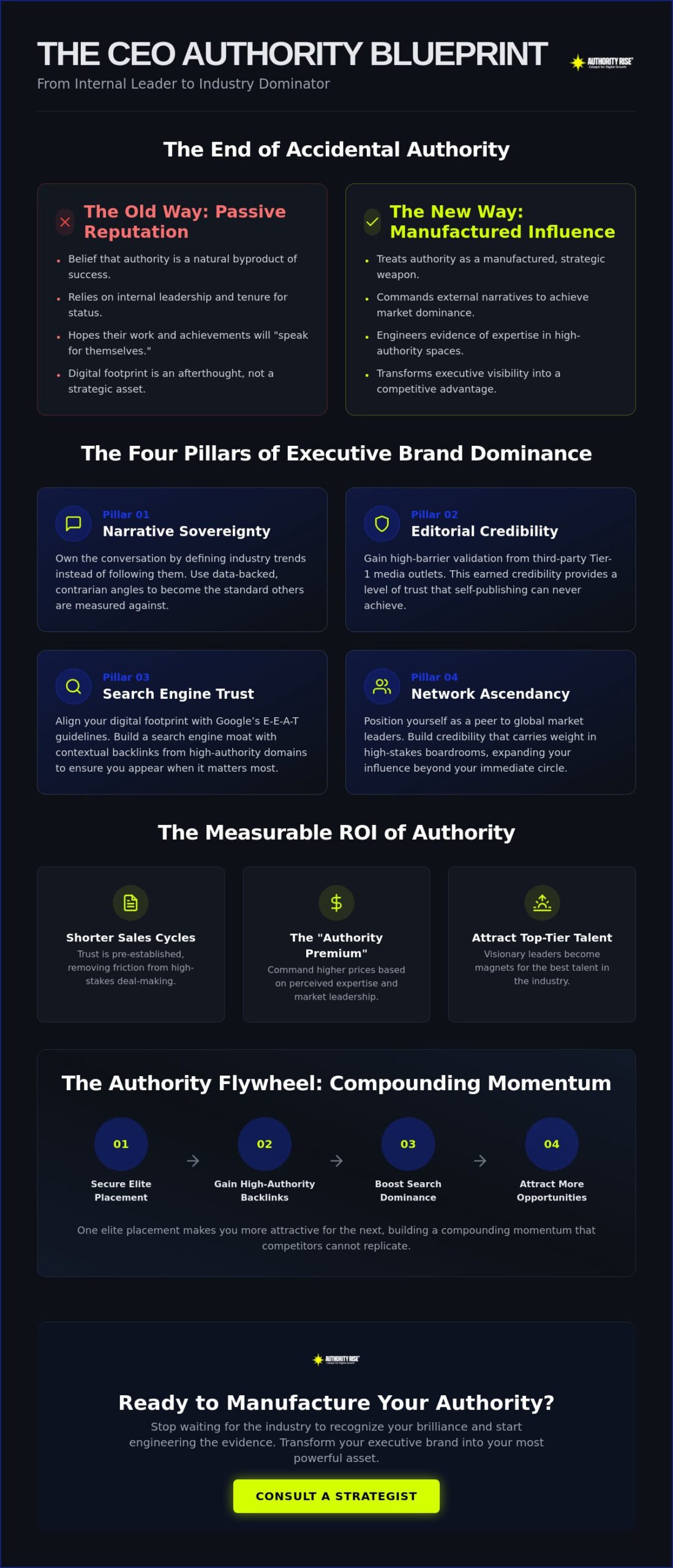
A clean Google search result is no longer a “nice to have”; it’s a mandatory prerequisite for enterprise-level deals. Passive reputation is a gamble that relies on people speaking well of you in private rooms. Active authority building for CEO success ensures that the right story is told in public, high-authority spaces. This creates an “Authority Flywheel.” One elite editorial placement makes you more attractive to the next, building a compounding momentum that competitors can’t easily replicate.
The ROI of the Authoritative Founder
The “Authority Premium” is the strategic ability to command higher prices based on perceived expertise. Beyond pricing power, this dominance directly impacts investor relations. Investors don’t just fund companies; they fund leaders who own their niche. When the market views a founder as an indispensable expert, the parent company’s Cost Per Acquisition (CPA) drops significantly. Your personal brand does the heavy lifting, warming up leads before they ever enter the funnel. Stop waiting for the industry to recognize your brilliance and start manufacturing the evidence.
The Four Pillars of Executive Brand Dominance
Authority is not a gift granted by the industry; it’s an architecture engineered through precision and intent. Most executives settle for a passive reputation, hoping their work speaks for itself. It won’t. In a crowded marketplace, you must manufacture the signals that command respect. Strategic authority building for CEO success rests on four non-negotiable pillars that transform a standard executive profile into a dominant market force. These pillars ensure your influence is both visible to human decision-makers and legible to search algorithms.
- Narrative Sovereignty: This is the art of owning the conversation. You don’t follow industry trends; you define them.
- Editorial Credibility: Stop talking to yourself on a corporate blog. True authority requires the high-barrier validation of third-party editorial placements.
- Search Engine Trust: Your digital footprint must align with Google’s E-E-A-T guidelines to ensure you appear when it matters most.
- Network Ascendancy: This positions you as a peer to global market leaders. It’s about building credibility with peers at the highest levels of commerce, ensuring your name carries weight in boardrooms you haven’t even entered yet.
Narrative Sovereignty and Strategic Positioning
Most leaders play it safe by repeating “best practices.” This is a recipe for invisibility. To achieve narrative sovereignty, you must identify a contrarian but correct industry angle. Find the friction points your competitors ignore. Use data-driven insights to back a bold claim that solves a high-level market pain point. When you speak with a unique, evidence-backed voice, you cease being a participant and become the standard. If your current profile lacks this strategic edge, it’s time to consult with a strategist who understands the mechanics of executive dominance.
The Role of E-E-A-T in CEO Branding
Google’s algorithm is a sophisticated judge of character. It looks for Experience, Expertise, Authoritativeness, and Trustworthiness (E-E-A-T) across your entire digital footprint. For a CEO, this means Google is tracking your “entity” across multiple high-DR (Domain Rating) domains. It looks for your byline on reputable news sites and your name in high-level industry reports. Passive visibility doesn’t cut it. Effective authority building for CEO profiles requires active placement of authoritative signals. When Google sees you as a trusted source, it doesn’t just rank your name; it elevates your entire company’s search standing. High-level editorial link building isn’t just PR; it’s a foundational SEO strategy that creates a moat around your corporate brand.
Editorial Placements vs. Social Media: The Credibility Gap
Social media is a low-barrier environment. Anyone with a smartphone can broadcast a message, which is precisely why it lacks inherent prestige. In contrast, elite editorial PR is a high-barrier ecosystem where access is guarded by professional gatekeepers. Effective authority building for CEO candidates requires recognizing that a post on LinkedIn is “owned” media, while a feature in a major publication is “earned” media. One feature in Forbes carries more weight in a high-stakes negotiation than 1,000 LinkedIn impressions. Impressions are vanity metrics. Credibility is a deal-closer.
A social post has a shelf-life of a few hours before it’s buried by an ever-changing algorithm. An indexed editorial article provides value for years, appearing every time a potential partner or investor conducts due diligence. Being “active on social” isn’t a strategy. It’s a chore. True authority is built through third-party validation that social platforms simply cannot provide. You don’t want to be the executive who is merely visible; you want to be the one who is vetted.
The Exclusivity of Tier-1 Media
Editorial gatekeepers at outlets like TechCrunch or Entrepreneur serve as trust-proxies for your audience. When they choose to publish your insights, they’re effectively vouching for your expertise. This creates a powerful “halo effect” where you appear alongside global industry titans. This third-party validation is the cornerstone of high-level authority building for CEO profiles. It transforms you from someone who claims to be an expert into someone who is recognized as one by the world’s most respected institutions. This psychological impact is what separates market leaders from also-rans.
Building a Multi-Channel Authority Stack
Social media is the distribution arm, but editorial is the validation arm. Don’t waste time creating original content for platforms that don’t own the search results. Instead, use your editorial features as the “source code” for your social media presence. A single high-level interview can be broken down into weeks of social content. This strategic redistribution allows you to maximize reach without sacrificing the prestige of the original placement. You’re no longer just shouting into the void; you’re amplifying a message that has already been vetted by the elite. It’s a disciplined approach that ensures every post reinforces your standing rather than diluting it. Executives who are serious about scaling brand authority online understand that this multi-channel discipline is what separates sustained market leaders from those who generate temporary buzz.
The Roadmap to Elite Placements: A Strategic Framework
Securing Tier-1 media isn’t a matter of luck; it’s a matter of methodology. Most executives fail because they treat media outreach like a volume game, sending generic “PR blasts” to overtaxed editors. This approach is a waste of capital. Dominant authority building for CEO success requires a disciplined protocol that prioritizes precision over noise. You must transition from being a solicitor to a strategic partner for the publications that matter most.
The roadmap to elite placements involves identifying a unique editorial hook, executing a bespoke pitching protocol, and ensuring the final content is crafted with authority. It’s about moving past the “sales pitch” and offering genuine industry foresight. Securing the live link is the final, critical step in this framework. Without a contextual, high-DR link, a media feature is merely a temporary PR win. With it, the placement becomes a permanent SEO asset that boosts your personal and corporate search standing. Post-publication maximization ensures the placement works for you for the next decade by integrating it into your sales funnels and investor decks.
Identifying High-Impact Editorial Angles
Journalists at major publications are not interested in your product launch. They are interested in how your insights help their readers solve a problem. To find your hook, mine your own company data for newsworthy patterns that your competitors are missing. For example, knowing that 30% of CEOs reported increased revenue from AI in the last 12 months (PwC’s 29th Global CEO Survey, January 2026) allows you to frame a narrative around AI-driven transformation rather than generic tech adoption. We utilize a “Problem-Solution-Proof” framework for every executive guest post. This ensures your narrative identifies a high-level market pain point, offers a contrarian solution, and provides the data-driven proof required for publication. This method avoids the “Sales Pitch Trap” that causes editors to reject 99% of CEO pitches immediately.
The Mechanics of High-DR Outreach
Relationships are the primary currency of high-level PR. Approximately 70% of PR agencies prefer retainer arrangements over project-based work for better strategic planning (Publicity For Good, March 2026), reflecting the need for consistent, disciplined execution in building a dominant public profile. The value of an elite agency lies in its direct access to editors who trust the quality of the insights provided. This is the difference between “pay-to-play” schemes, which we strictly avoid, and “earned editorial placements” that carry genuine weight. Executives who want to understand how data driven PR campaigns bypass media gatekeepers and secure Tier-1 placements will find this approach far more effective than traditional outreach. If you are ready to stop guessing and start dominating, our team provides the Brand Authority & Editorial PR infrastructure needed to secure these high-stakes placements.
Converting Media Authority into Search Dominance
Authority isn’t just about prestige; it’s about PageRank. In 2026, the most resilient SEO strategy isn’t found in a spreadsheet of keywords. It’s found in the editorial sections of high-authority publications. Effective authority building for CEO success bridges the gap between digital PR and search dominance by capturing contextual backlinks that algorithms cannot ignore. Impressions are fleeting, but an indexed backlink from a high-DR publication is a permanent revenue driver that compounds over time.
Editorial link building creates a defensive “moat” around your brand name. Most executives ignore their search results until a crisis occurs, leaving their narrative to chance. A proactive strategy ensures that when a prospect or investor searches for your leadership, they find a wall of high-authority results that you’ve strategically engineered. This is the ultimate white-hat strategy because it relies on genuine merit and human editorial approval rather than technical loopholes or automated networks. You aren’t just ranking a page; you’re codifying your expertise into the global search index. The most effective executives pair this editorial approach with a comprehensive plan for scaling brand authority online to ensure every placement compounds into long-term search dominance.
The Synergy of PR and SEO
A single link from a Tier-1 outlet like TechCrunch or Forbes passes more “authority juice” than 100 low-tier, automated blogs. These editorial placements signal to Google that you are a verified entity of significance. This is the core of authority building for CEO profiles. Over time, these high-DR mentions elevate your personal and corporate Domain Rating (DR), making every piece of content you publish rank faster and stay at the top longer. Success isn’t measured by social media “likes” that disappear in hours. It’s measured by the percentage of your industry’s search volume you own and the quality of the domains vouching for your expertise. If your PR efforts don’t result in a stronger search presence, they’re merely vanity exercises.
Selecting an Elite Authority Partner
Building this level of dominance requires more than a PR agency with a list of contacts. It requires a strategic partner who understands the intersection of media relations and search dynamics. Most agencies focus on the clip; we focus on the impact. Authority Rise Catalyst focuses on substance and merit-based placements because we know that superficial visibility is a temporary gain. We treat your executive profile as a high-value asset that requires precise craftsmanship and disciplined execution. Stop settling for a passive reputation and start demanding market dominance. We encourage you to contact our strategists to audit your current digital authority and map out a path toward genuine industry leadership.
Command Your Market Narrative
Executive dominance in 2026 requires a departure from passive reputation management. You’ve seen that true influence isn’t found in high-volume social posting; it’s forged in the high-barrier exclusivity of Tier-1 editorial placements. By aligning your narrative sovereignty with strategic digital PR, you create a search engine moat that competitors can’t breach. This disciplined approach to authority building for CEO success transforms visibility into a measurable, long-term competitive advantage.
We specialize in data driven PR campaigns that have secured features in Forbes, Entrepreneur, and TechCrunch. Our methodology focuses on strategic editorial link building that delivers high-DR impact and sustainable search dominance. Don’t leave your legacy to the whims of an algorithm or the noise of social media. It’s time to manufacture the credibility your expertise deserves. Secure your place among the industry elite with Authority Rise Catalyst. The future belongs to those who own the conversation.
Strategic Insights: Executive Authority FAQ
What is the fastest way for a CEO to build authority?
Securing high-tier editorial placements is the most efficient path to market dominance. Third-party validation from respected media outlets provides an immediate credibility boost that self-published content cannot replicate. It’s about moving past the noise of social media and earning the endorsement of industry gatekeepers. This approach transforms your reputation from a participant to a recognized leader in weeks rather than years.
How much time does a CEO need to commit to an authority building program?
An elite program requires approximately two to four hours of executive time per month. Most of the heavy lifting, including research, narrative development, and media outreach, is managed by your strategic partner. Your role is to provide the raw expertise and unique perspective during brief strategy sessions. It’s a disciplined investment of time designed to maximize output without disrupting your operational focus.
Is authority building different for founders of startups vs. CEOs of established firms?
The core mechanics remain the same, but the strategic narrative shifts significantly. Founders must focus on “visionary disruption” to prove their concept’s future viability in a competitive market. Established CEOs, however, utilize authority building for CEO frameworks to solidify industry dominance and protect market share. One group builds a new table; the other ensures they remain at the head of the existing one.
Can authority building help with my company’s SEO rankings?
Contextual backlinks from high-DR editorial pages are the most powerful ranking signals in modern search. When a Tier-1 publication links to your corporate domain within an authoritative article, it passes significant “authority juice” to your site. This synergy between PR and SEO creates a sustainable search moat. Your personal visibility directly elevates the search standing of your entire organization.
What are the risks of a poorly executed executive branding campaign?
Poor execution leads to diluted credibility and a permanent digital record of low-quality content. “Pay-to-play” schemes and generic guest posts signal desperation rather than leadership to sophisticated peers and investors. Once a weak narrative is indexed by search engines, it becomes a liability that’s difficult to overwrite. True authority building for CEO success requires substance and merit; shortcuts only damage your long-term standing.
How do I get featured in Forbes or Entrepreneur as a guest contributor?
Journalists and editors demand data-driven, contrarian insights that solve high-level reader pain points. They don’t want a thinly veiled sales pitch or a recycled industry trend. You must offer a unique perspective backed by proprietary data or significant experience. Bespoke outreach through established agency relationships is the only reliable way to bypass the thousands of generic pitches these editors receive daily.
Does authority building require a massive social media following?
Prestige is not a popularity contest. A massive following is often a vanity metric that fails to influence high-stakes deals or investor sentiment. True authority is about the caliber of the platform and the quality of the audience you reach. A single feature in a publication read by your peers is worth more than 10,000 low-intent followers on a social platform.
How do I measure the ROI of authority building for a CEO?
Measure success through shortened sales cycles, increased inbound investor inquiries, and improved corporate Domain Rating. You’ll also see a noticeable reduction in Cost Per Acquisition as trust is pre-established before the first sales call. Authority is a strategic asset that delivers measurable financial outcomes. It isn’t just about feeling important; it’s about making your company more valuable and easier to scale.
Disclaimer
Website Blog Disclaimer
Last Updated: June 28, 2026
The information published on the Authority Rise Catalyst blog is provided for general informational and educational purposes only. While we strive to ensure that all content is accurate, relevant, and up to date, we make no guarantees regarding the completeness, accuracy, reliability, or suitability of any information on this website.
The content on this blog should not be considered professional legal, financial, tax, medical, or business advice. You should always consult a qualified professional before making decisions based on the information provided here.
Authority Rise Catalyst shall not be held liable for any loss, damage, or inconvenience arising from the use of, or reliance upon, the information available on this website. Your use of this website and its content is entirely at your own risk.
Some articles may contain links to third-party websites for your convenience. We do not control or endorse the content, services, or policies of these external websites and are not responsible for any information or services they provide.
Certain blog posts may contain affiliate links. If you purchase products or services through these links, we may earn a small commission at no additional cost to you. These commissions help support the operation and maintenance of our website. We only recommend products or services that we genuinely believe may provide value to our readers.
Some content may be created or enhanced using artificial intelligence (AI) tools. Every effort is made to review and edit AI-assisted content before publication; however, errors or omissions may still occur.
All opinions expressed on this blog are those of the respective authors and do not necessarily represent the views of any organizations, companies, or clients associated with Authority Rise Catalyst.
All text, graphics, logos, images, and other content published on this website are protected by applicable copyright and intellectual property laws unless otherwise stated. Unauthorized reproduction, distribution, or commercial use of any content is prohibited without prior written permission.
By accessing and using this website, you acknowledge that you have read, understood, and agreed to this disclaimer. We reserve the right to modify or update this disclaimer at any time without prior notice. Continued use of the website after changes constitutes acceptance of the updated disclaimer.
If you have any questions regarding this disclaimer, please contact us through the contact page on our website.