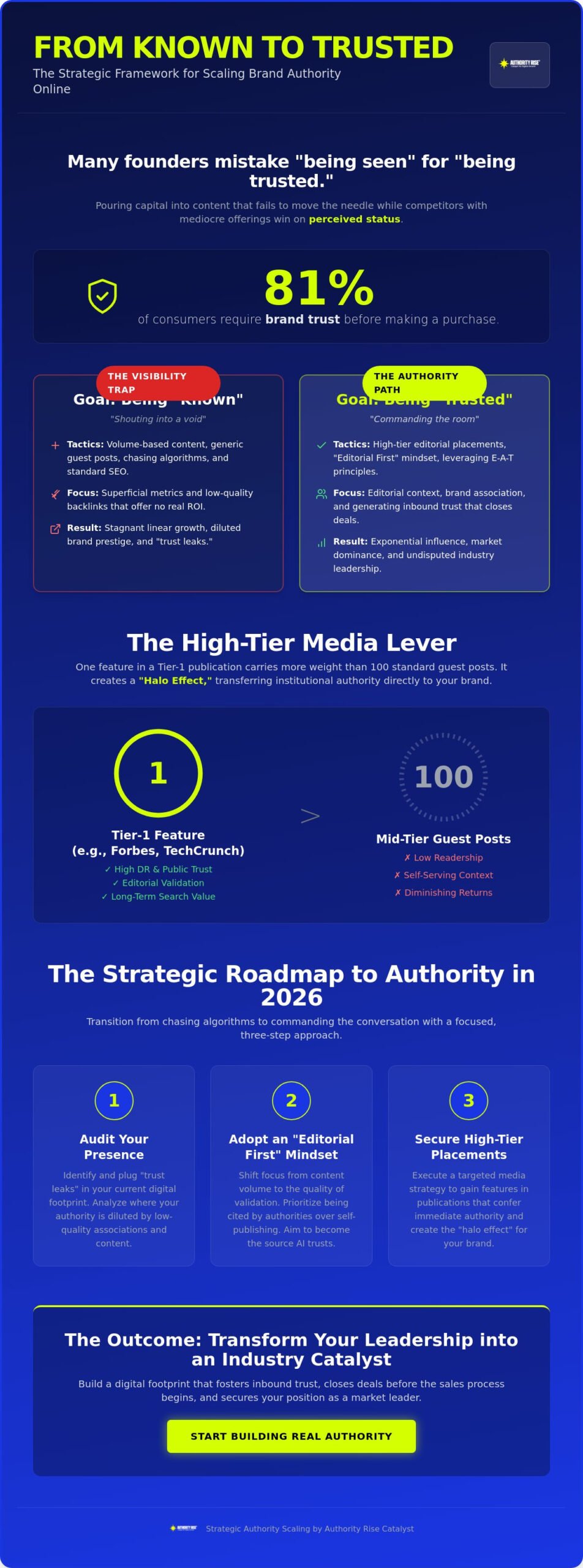
Your digital footprint is expanding, yet your influence remains stagnant. Many founders mistake “being seen” for “being trusted,” pouring capital into content that fails to move the needle while competitors with mediocre offerings capture the market’s attention. They aren’t outperforming you on merit; they’re outperforming you on perceived status. With 81% of consumers now requiring brand trust before making a purchase, scaling brand authority online has become the only viable path to sustainable market dominance.
You’re likely tired of seeing inferior brands featured in outlets like TechCrunch while your own expertise stays buried under low-quality backlinks that offer no real ROI. This article outlines the strategic framework to transition from mere visibility to undisputed industry leadership through high-tier editorial strategy. We’ll examine how to secure Tier-1 media placements and generate the kind of inbound trust that closes deals before you even start a sales call. It’s time to stop chasing algorithms and start commanding the conversation.
Key Takeaways
- Identify the critical distinction between being “known” and being “trusted” to move beyond linear growth toward exponential influence.
- Leverage high-tier editorial placements to create a “halo effect” that transfers institutional authority directly to your brand’s reputation.
- Execute a strategy for scaling brand authority online that prioritizes editorial context and association over superficial search metrics.
- Transform executive leadership into industry catalysts by building a digital footprint that fosters inbound trust before the sales process begins.
- Audit your current presence for “trust leaks” and design a narrative framework that secures your position as a market leader in 2026.
Defining Brand Authority in the Age of Information Density
Most brands mistake noise for influence. They operate under the delusion that if they publish enough content, the market will eventually bow. It won’t. There’s a massive, often ignored gap between being “known” and being “trusted.” In 2026, brand authority isn’t about the volume of your output; it’s about the weight of your validation. While many founders settle for linear growth by churning out endless blog posts, elite leaders focus on exponential scaling through high-tier editorial validation. This is the difference between shouting into a void and commanding a room.
Search engines have evolved far beyond the era of simple keyword density. Modern algorithms prioritize Expertise, Authoritativeness, and Trustworthiness (E-A-T) because they’re designed to filter out the digital static. This shift has birthed the need for “Authority Catalysts.” These are specific, high-impact media actions that trigger rapid trust gains by associating your brand with established, reputable institutions. When you align with these catalysts, you stop begging for attention and start receiving it as a matter of course.
The Difference Between Visibility and Authority
Visibility is cheap. Anyone with a credit card can buy eyes on a page, but those eyes don’t necessarily see a leader. Authority is the state of being listened to as a definitive industry source. A thousand mentions on low-tier, pay-to-play sites don’t just fail to help; they can actually dilute your brand prestige. True authority is rooted in Brand equity, where the value of your name alone drives consumer behavior and commands premium pricing. Earned media remains the ultimate trust signal because it represents a third-party endorsement that cannot be faked or bought through standard advertising channels.
Why Conventional SEO Is No Longer Enough
Standard SEO has reached a point of diminishing returns for those seeking market dominance. AI-generated content has commoditized the traditional blog post, making it impossible to stand out through volume alone. Google now rewards brands that exist in “real world” high-authority contexts. If your brand is only mentioned on your own domain, you’re a self-proclaimed expert. If you’re cited by Forbes or TechCrunch, you’re an industry leader. The algorithm recognizes this distinction and ranks you accordingly.
Scaling brand authority online requires an “Editorial First” mindset. This approach moves away from technical manipulation and toward genuine strategic depth. It’s about ensuring your brand is cited as an authoritative source by the very engines that now summarize information for users. You don’t just want to rank for a term. You want to be the source the AI trusts to answer the question. This level of dominance is reserved for those who prioritize substance over superficial metrics.
The High-Tier Media Lever: Scaling Beyond Personal Channels
Most companies drown in the volume trap. They believe that churning out generic guest posts on mid-tier sites will eventually tilt the scales in their favor. It won’t. In the hierarchy of influence, one feature in a tier-1 publication like Forbes or TechCrunch carries more weight than 100 standard guest posts on platforms no one actually reads. This is the high-tier media lever. It’s the most efficient mechanism for scaling brand authority online because it leverages the massive, pre-existing reputation of global media giants to validate your own.
When a publication with a high Domain Rating (DR) and even higher public trust features your brand, a “halo effect” occurs. Their authority transfers to you. This isn’t just a technical SEO benefit; it’s a psychological shortcut for your prospects. A permanent, high-DR editorial link provides long-term search value that survives algorithm updates because it’s rooted in genuine human relevance. If you’re looking to redefine your market position, starting a conversation with an authority strategist can help you identify which levers to pull first.
Why One Forbes Feature Outperforms 100 Blogs
Content on your corporate blog is self-serving. It’s expected. Conversely, content in a major editorial outlet is curated and vetted by external gatekeepers. Editorial Validation is the third-party endorsement that converts skeptics into believers. This external proof is especially critical when executing authority building for CEOs, where the leader’s personal reputation must be beyond reproach. Successful executives use these platforms to build high-authority brands that dominate search results and industry mindshare simultaneously.
The Psychology of Editorial Validation
The “As Seen In” section on a website isn’t just decoration. It’s a badge of pre-vetted quality that shortens the B2B sales cycle significantly. Readers perceive these logos as a signal that your brand has already passed a rigorous “stress test” by industry experts. This level of validation doesn’t just attract customers; it fundamentally changes your standing with investors and top-tier talent. When you are featured in the right contexts, you stop competing for space in an existing market and begin to define a new category entirely. You aren’t just another option. You’re the definitive choice.
Editorial Link Building: Scaling Authority Through Association
Link building is often treated as a game of accumulation. Amateurs chase quantity, filling spreadsheets with low-quality directory submissions and risky PBN links that search engines increasingly devalue. Elite strategists recognize that scaling brand authority online is a game of association. It’s not about how many links you have; it’s about the caliber of the neighborhoods where your brand resides. A link from a high-authority editorial piece is a vote of confidence that signals relevance to both users and algorithms. This is why we focus on high-tier placements that align your brand with established industry giants.
The market for link building has split into two distinct tiers. The low end consists of high-risk, automated tactics that offer no real strategic value. In contrast, high-end editorial link building involves manual outreach to legitimate websites with real traffic and strict editorial standards. This approach ensures your brand is mentioned within the context of high-traffic, trending news stories. When your brand is cited as a source in a breaking industry report, you aren’t just gaining a backlink. You’re gaining a permanent seat at the table of industry leaders.
Contextual Placements vs. Directory Noise
Context is the currency of modern SEO. A link buried in a sidebar or a generic directory carries negligible weight compared to one integrated into an expert-led narrative. Links inside expert-written articles carry ten times the influence because they’re surrounded by semantic relevance. This avoids the “Bad Neighborhood” risk, where association with low-quality sites actually drags down your brand’s perceived value. We prioritize a natural anchor text strategy to avoid the over-optimized patterns that trigger penalties. Precision in placement ensures that your brand’s perceived value remains high in the eyes of both human readers and AI scrapers.
Identifying High-DR Editorial Opportunities
Securing “dofollow” editorial value requires more than just outreach. It requires a data-driven PR approach that creates stories journalists actually want to cite. By providing unique insights or proprietary data, your brand becomes a necessary reference point in the industry conversation. This creates a cycle of permanent, high-DR placements that stabilize your search rankings over the long term. You can explore our blogs to see how high-impact link strategies differ from standard industry practices. The goal is to move from being a participant in the market to being the benchmark for it. High-tier editorial placements ensure your brand’s association is with excellence, not just existence.
Executive Presence: Turning Founders into Industry Catalysts
Faceless corporations are a relic of the past. In 2026, trust is a peer-to-peer currency. People don’t buy from logos; they buy from leaders who possess a clear, authoritative voice. This human element is the most powerful lever for scaling brand authority online. Whether through high-impact media features or professional corporate video production Canberra, when a founder steps into the spotlight as an industry catalyst, the entire organization benefits from the reflected credibility. You aren’t just building a company; you’re cultivating a legacy of expertise that the market can’t ignore.
Bridging the gap between a founder’s deep expertise and a journalist’s immediate needs is the core of high-level PR. It requires a transition from being a participant in the market to being a primary source for the media. This creates a “Multiplier Effect.” A strong executive brand lowers the friction of corporate PR. Journalists are more likely to respond to a person they recognize as a thought leader than a generic press release from a faceless marketing department. This organic pull reduces the cost of high-tier media acquisition and accelerates the entire growth trajectory of the business.
The CEO as the Brand’s Primary Trust Signal
Search algorithms have become sophisticated enough to track individual reputations across the web. Google’s emphasis on “Author” profiles means that a CEO with a history of high-tier contributions is treated as a verified expert. An executive byline in Entrepreneur or TechCrunch doesn’t just drive traffic. It increases brand search volume and provides a foundational layer of trust. Understanding how to get featured in Forbes is no longer a vanity project; it’s a strategic necessity for executive dominance. When the leader is validated, the brand is validated.
Crafting a Narrative That Journalists Actually Want
Most founders fail in the media because they lead with their product. Journalists don’t care about your features; they care about your vision and how it impacts the industry. You must move away from “Product First” pitches and adopt “Vision First” editorial angles. This involves using unique data or contrarian insights to secure recurring media interest. It’s about identifying a gap in the current industry narrative and filling it with substance that forces the market to pay attention.
You are a source, not a salesperson. When you provide journalists with substantive, merit-based perspectives that challenge conventional wisdom, you become an indispensable asset to their reporting. This shift in positioning ensures your brand remains at the forefront of the industrial conversation. If you are ready to elevate your executive footprint and dominate your niche, contact our strategy team to begin your transition into an industry catalyst.
The Strategic Roadmap to Authority Scaling in 2026
Execution is the graveyard of good intentions. While many founders understand the value of influence, few possess the discipline to build it methodically. Scaling brand authority online requires a shift from sporadic activity to a high-tier offensive. This roadmap isn’t about chasing the latest algorithm update. It’s about building a fortress of credibility that makes your brand the only logical choice in your market. Success in 2026 demands a process that is as rigorous as your product development.
The journey begins with a ruthless audit. You must identify “trust leaks” where your digital presence contradicts your actual expertise. Once these gaps are closed, you move into Narrative Design. This involves developing core editorial pillars that position your brand as a visionary force rather than a commodity provider. From there, execution moves into disciplined outreach and strategic amplification. Every earned media win must be leveraged across your internal and social channels to maximize its lifespan. Finally, the focus shifts to conversion, ensuring that your elevated status translates directly into measurable pipeline growth.
- Audit: Assess current authority gaps and identify where prospects lose trust.
- Narrative Design: Build the editorial pillars that will drive your PR and media interest.
- Outreach: Execute a high-tier pitch strategy focused on Tier-1 publications.
- Amplification: Use earned media to fuel your social proof and sales collateral.
- Conversion: Align your authority with your lead generation to drive revenue.
Moving from Reactive PR to Proactive Dominance
Stop waiting for the news cycle to find you. Industry leaders don’t react to conversations; they create them. The “One-Off” press release is a relic of an era where visibility was enough. Today, you need an “Always-On” authority model that consistently places your expertise in front of the right gatekeepers. This proactive stance ensures you’re never at the mercy of a quiet news week. If you’re ready to scale, you need a partner who understands how to manufacture momentum.
Measuring Success Beyond Simple Traffic Metrics
Traffic is a vanity metric if it doesn’t come with trust. In 2026, the real indicators of success are your “Share of Voice” in top-tier publications and the impact on branded search volume. You should track how your authority status affects lead quality and sales cycle length. When prospects enter the first call already trusting your expertise, your PR is working. You can review our FAQs to learn more about how we measure the tangible ROI of high-level brand scaling. True dominance is found in the numbers that actually impact your bottom line.
Commanding the Market: Your Path to Undisputed Influence
Market dominance isn’t a byproduct of volume; it’s a result of strategic positioning. You’ve seen how the shift from self-promotion to elite editorial validation creates a level of trust that standard marketing simply cannot replicate. By leveraging high-tier media and transforming leadership into a primary trust signal, you move beyond the “hollow middle” of digital visibility. Scaling brand authority online is about ensuring your name is synonymous with expertise in the eyes of both prospects and search engines.
Our team has a proven track record of securing placements in Forbes, Entrepreneur, and TechCrunch, using a data-driven PR methodology that bypasses traditional gatekeepers. We don’t just build links; we build genuine industry standing. If you’re ready to stop competing on price and start winning on merit, it’s time to refine your strategy. We’ve mastered the art of scaling DR for high-growth executives who refuse to settle for mediocre results.
The transition from a well-kept secret to a recognized authority is within your reach. Let’s begin the work of defining your dominance and securing your legacy in the digital age.
Frequently Asked Questions
How long does it take to see results from scaling brand authority?
Results generally manifest within 90 to 180 days as the cumulative weight of high-tier placements begins to influence search algorithms and prospect perception. While a single feature in a major outlet provides an immediate trust signal, true market dominance requires a sustained editorial cadence. This timeline allows for the indexing of high-DR links and the stabilization of branded search volume across the digital landscape.
Is it better to focus on many small publications or one large one?
One feature in a Tier-1 publication is fundamentally more valuable than dozens of mentions in obscure, low-traffic blogs. High-tier media provides a “halo effect” that transfers institutional trust directly to your brand, whereas smaller sites often lack the authoritative weight required for scaling brand authority online at an exponential level. You should prioritize placements that carry the most significant editorial validation to ensure your brand is associated with industry excellence.
Can brand authority help with SEO rankings directly?
Brand authority influences SEO rankings by signaling Expertise, Authoritativeness, and Trustworthiness (E-A-T) to search engines. When high-authority domains link to your site within a relevant editorial context, it validates your content as a definitive source. This results in higher domain authority and improved visibility for competitive keywords. You aren’t just ranking for terms; you’re becoming the source the algorithm trusts to answer the market’s most critical questions.
What is the difference between digital PR and traditional PR?
Traditional PR focuses on broad awareness through print and broadcast, often lacking a measurable digital impact or long-term search benefit. Digital PR is a strategic evolution that prioritizes high-quality backlinks, search visibility, and inbound trust. It bridges the gap between media relations and technical SEO. This approach ensures that every media win contributes to your permanent digital footprint rather than disappearing after a single news cycle ends.
Do I need to be a large company to build brand authority online?
Headcount is irrelevant to authority. Ambitious founders and mid-market firms often build more potent authority than bloated corporations because they can take bolder, more contrarian stances that journalists find compelling. Media outlets seek unique insights and visionary perspectives, not corporate size. By positioning yourself as a specialized industry catalyst, you can effectively outmaneuver larger competitors who rely on generic, safe marketing strategies that fail to inspire trust.
How much does an editorial link building campaign cost?
Investment levels for editorial link building vary significantly based on the complexity of the campaign and the target publication’s tier. High-end editorial placements require a sophisticated approach involving manual outreach, narrative design, and the creation of proprietary data. Unlike low-tier, high-risk tactics that offer temporary or harmful gains, strategic editorial link building is a long-term investment in your brand’s permanent digital standing and market influence.
Can I get featured in Forbes if I am not a writer?
You don’t need to be a professional writer to secure a feature in Forbes or other Tier-1 outlets. Journalists and contributors are constantly searching for expert sources who can provide unique data or a provocative industry perspective to ground their reporting. By acting as a primary source or being interviewed for a trending story, you gain high-tier validation without ever drafting a single paragraph yourself. It’s about the value of your expertise, not your prose.
What happens if my brand has negative search results while scaling?
Scaling brand authority is the most effective method for managing and repairing your digital reputation. By securing a consistent stream of positive, Tier-1 media placements, you effectively suppress negative or irrelevant search results. These high-authority pages naturally outrank lower-quality content due to their superior domain strength. This ensures that when prospects search for your name, they encounter validated excellence rather than outdated or misleading information, turning your search results into a proactive defense.
Disclaimer
Website Blog Disclaimer
Last Updated: June 28, 2026
The information published on the Authority Rise Catalyst blog is provided for general informational and educational purposes only. While we strive to ensure that all content is accurate, relevant, and up to date, we make no guarantees regarding the completeness, accuracy, reliability, or suitability of any information on this website.
The content on this blog should not be considered professional legal, financial, tax, medical, or business advice. You should always consult a qualified professional before making decisions based on the information provided here.
Authority Rise Catalyst shall not be held liable for any loss, damage, or inconvenience arising from the use of, or reliance upon, the information available on this website. Your use of this website and its content is entirely at your own risk.
Some articles may contain links to third-party websites for your convenience. We do not control or endorse the content, services, or policies of these external websites and are not responsible for any information or services they provide.
Certain blog posts may contain affiliate links. If you purchase products or services through these links, we may earn a small commission at no additional cost to you. These commissions help support the operation and maintenance of our website. We only recommend products or services that we genuinely believe may provide value to our readers.
Some content may be created or enhanced using artificial intelligence (AI) tools. Every effort is made to review and edit AI-assisted content before publication; however, errors or omissions may still occur.
All opinions expressed on this blog are those of the respective authors and do not necessarily represent the views of any organizations, companies, or clients associated with Authority Rise Catalyst.
All text, graphics, logos, images, and other content published on this website are protected by applicable copyright and intellectual property laws unless otherwise stated. Unauthorized reproduction, distribution, or commercial use of any content is prohibited without prior written permission.
By accessing and using this website, you acknowledge that you have read, understood, and agreed to this disclaimer. We reserve the right to modify or update this disclaimer at any time without prior notice. Continued use of the website after changes constitutes acceptance of the updated disclaimer.
If you have any questions regarding this disclaimer, please contact us through the contact page on our website.